

Learn extra at:
Most likely among the many most generally used {hardware} interfaces seen in client electronics lately is the USB. Short for Universal Serial Bus, the USB first emerged within the Nineteen Nineties when a gaggle of engineers got here collectively to design a connector that is suitable with a number of units and may ship each energy and quick information. This versatility and comfort rapidly satisfied many corporations to undertake the USB till it grew to become an industry-standard connection.
Because of this reputation, growth on the USB continues to at present. In actual fact, it has come a good distance from the USB-A connector and USB 1.0 commonplace that first got here out. You will now see various kinds of USB, with totally different shapes and totally different requirements. So, how are you going to inform which is which? If you have to determine the particular USB ports and connectors in your units, you’ll be able to merely take a look at their form and shade, or examine their symbols and markings.
By the USB port’s form and shade
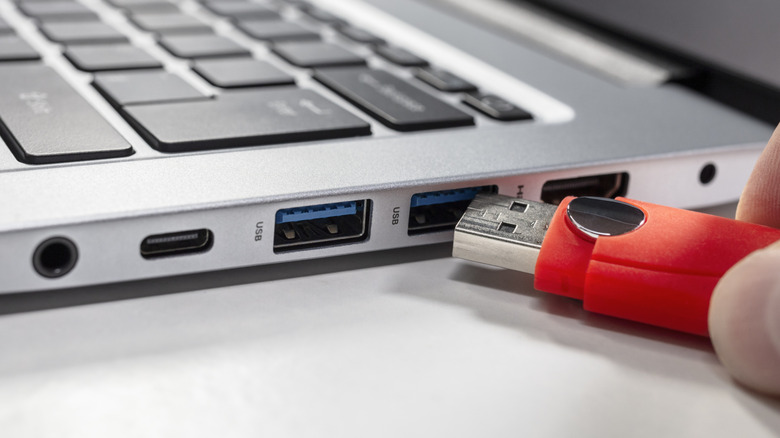
The form and shade of your USB port are clear clues of what sort of port it’s. Based mostly on adoption, there are six most important shapes to look out for.
The simplest to pinpoint is the oblong USB-A. It is a widespread port in a slew of units, together with computer systems, TVs, flash drives, and even energy strips. It is essential to notice, although, that not all USB-A are created equal. These USB ports can come in different colors: white for USB 1.0 and USB 1.1, black for USB 2.0, blue for USB 3.0 or 3.1, and different colours that point out particular features like “All the time On.”
One other sort of USB port you may often see in your units is USB-C. It is small and oval-shaped, nevertheless it should not be confused with the older Apple fashions’ Lightning port. Whereas the USB-C port features a central piece, the Lighting port would not. It is typical to search out USB-C ports in trendy telephones, laptops, and different rechargeable electronics like followers and moveable audio system. Moreover the widespread USB-A and USB-C, you even have USB-B. It has a boxy form with angled corners and is the same old port for printers and scanners.
Lastly, there’s the mini-USB, micro-USB, and micro-USB 3.0 Tremendous Pace. Each the mini-USB and micro-USB seem like a small trapezoid, however the micro-USB is slim just like the USB-C, whereas the mini-USB is a bit thicker. The micro-USB 3.0, alternatively, is a fusion between a small trapezoid and a rectangle subsequent to one another. These three USB ports was distinguished in older units — the mini in cameras and MP3 participant, the micro in Android telephones/tablets, and the micro-USB 3.0 in exterior drives. Because the introduction of USB-C, many manufacturers dropped these USB sorts to modify over to the brand new connector.
By the USB port’s symbols
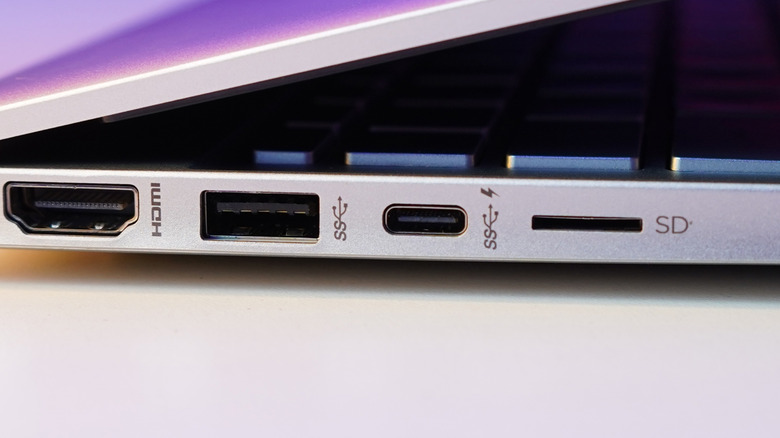
Aside from the form and shade of the USB port, it’s also possible to examine the port’s symbols and markings to determine its sort, particularly its USB commonplace. These symbols are often printed close to the port, so they need to be exhausting to overlook. Essentially the most primary USB image — and possibly the one you are most acquainted with — is the naked sideways trident whose base is a circle on the left. It represents USB 2.0, and you will discover it on a lot of the most important USB port shapes.
If the trident begins with an SS mark, with or and not using a quantity on the proper, then it is a USB 3.2. This similar emblem stays constant for the remainder of the USB 3.2 variations, with the quantity altering relying on the technology. USB 3.2 Gen 1 with or and not using a 5, means it options at most 5 Gbps speeds; USB 3.2 Gen 2 has a ten for 10 Gbps; and USB 3.2 Gen 2×2 has a 20 for 20 Gbps. The SS trident seems on USB Sort A, B, C, and micro B, however the USB 3.2 Gen 2×2 is an exception because it’s unique to USB-C.
For the USB 4 commonplace, the trident stays however the SS mark is changed by both 20 or 40. The quantity signifies the model and most information switch velocity: 20 for USB 4 Gen 2×2 which has 20 Gbps, and 40 for USB 4 Gen 3×2 with 40 Gbps. Each USB 4 logos can solely be seen on USB-C ports.
On prime of those symbols representing the USB requirements, you may additionally discover different markings on the USB ports. For example, generally, there is a lightning bolt on the USB port of computer systems, which implies it could possibly cost your units even when the pc is off. If it is a lightning bolt ending in an arrow, although, that is the icon for Thunderbolt, a robust multi-purpose USB-C port.

